Some time back Anthony Bradley asked the question of whether any doctoral graduates of evangelical institutions (e.g. Fuller, Southern, TEDS, Westminster, Wheaton) taught at Ivy League schools. Bradley’s question was rhetorical – of course they don’t, because those degrees aren’t worth as much. I decided to look into this and found that Bradley’s assumption is largely correct.
I looked at the divinity schools, seminaries, and department of religions for all of the Ivy League schools, plus American schools that typically rank in the top ~50 universities globally for religion and the humanities. Some, like Cal Tech, Johns Hopkins, M.I.T., and the University of Michigan didn’t have relevant faculty or departments. Others, like Columbia and Princeton, used neighboring seminaries (Union and Princeton, respectively). There was a lot of cross-pollination (inbreeding?) between the top schools, among the Ivy League especially. The more elite the school, the more uniform was its faculty. The more explicitly theological the school (e.g. Duke, Princeton) the more institutional diversity was present among its faculty.
There was a single faculty member of these schools with a doctorate from an evangelical institution (at Duke, from Southern Baptist Theological Seminary – a professor of Baptist studies). Below I outline a couple of overlapping theories of why. I also list out the schools and faculty with any master’s degree from evangelical institutions…
Whatever you think of National Conservatism, Timon Cline’s writeup on the Christian nature of the United States is well worth the read. It begins with a critique of Mark Tooley’s approach to public Christianity:
Tooley warns that coercion, which presumably encompasses culturally cultivated social stigma, never works. As a good son of the Great Awakenings, he insists that only spontaneous revival will root the nation in transcendence. Any hint of state involvement therein, any governmental thumb on the scale, would be counterproductive, making religion forced, stale, or counterfeit. Best to not meddle as to not muddle.
Hypothetically, if national conservatives are “establishmentarians,” then we could call Tooley’s position “public atheism.” This is not to imply that Tooley or Christians like him—and there are many—are disingenuous or embarrassed by Christianity and the Bible. Rather, public atheism is a typical right-liberal posture akin to what used to be called practical atheism.
Public atheism, for our purposes, is marked by suspicion of, and hostility to, whatever smells of formal, state-level recognition and privileging (i.e., honor) of Christianity over and against other faiths on offer. It decries “public Christianity” as an artificial limitation of the realm of possibility. It is, in a word, pluralism, insofar as it features a kind of religious market fundamentalism.
Modified from a text conversation.
Why should only Teaching Elders (pastors) and not Ruling Elders (lay elders) administer the sacraments? Why are the sacraments (normally) not properly administered otherwise? Here are the broad strokes of my reasoning, with particular application to the EPC. A more detailed breakdown can be found on pages 30-38 of the document linked in this post.
Biblical theology: The sacraments are part of the churchly ministry granted to the apostles (e.g. Matthew 16:19, 18:18-19, 28:19; John 20:23; 1 Corinthians 4:1, 11:23). The authority to administer sacraments is not entrusted to just anyone in the church. Teaching Elders as pastors stand in continuity with this apostolic ministry (i.e. apostolic succession) – e.g. Romans 15:15-17; 1 Corinthians 12:27-29, 14:1; Ephesians 2:20-22, 3:7, 4:9-11; 1 Peter 5:1. Whatever Ruling Elders are, they are not an apostolic, sacramental office. Pastors (or bishops, or ministers, or Teaching Elders, or whatever your preferred term) do stand in ministerial, apostolic succession, and therefore do have a sacramental nature to their office. Teaching Elders have been authorized by Christ to administer the sacraments, Ruling Elders have not…
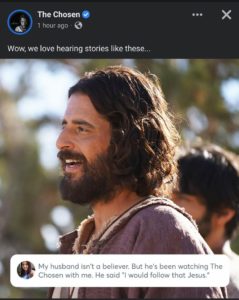
This is the problem with visually imaging Jesus for the sake of non-Christians. They love the Jesus of man’s imagination and creation, not the Jesus of the word.
My four-point defining feature of confessionalists, in distinction from evangelicals and pietists, is that they are
- Church oriented, grounded in the Anglican, Lutheran, Presbyterian, or Reformed traditions arising from the Protestant Reformation in the 16th-17th centuries.
- Church forms matter and are central for spiritual life, especially liturgical and doctrinal formulations, along with polity.
- Spiritual practice orbits the public worship of the church, with emphasis on preaching, the sacraments, and prayer.
- Ordinary life in the world is good and welcome.
In Reformed and Evangelical Across Four Centuries: The Presbyterian Story in America (2022), historians from four different American Presbyterian churches wrote on the subject of the intersection between Presbyterians and evangelicals…