A Summary of Actions Taken by the 44th General Assembly of the EPC
This week my denomination, the Evangelical Presbyterian Church, held its 44th stated General Assembly in Memphis, Tennessee. This is the annual meeting and council (synod) of my church, and every pastor has a right to attend and every congregation may send elder representatives. This was a busy and lively assembly. Many things went on at the assembly, but below is a summary of its official actions.
To amend the EPC’s constitution requires a majority vote of one assembly, a majority vote of three-fourths of the presbyteries over the next year, and then a majority vote of the subsequent assembly. The assembly completed this process for an area that is essentially cleaning up language. The Book of Government places the authority over a local church’s budget in the hands of the Session (board of elders). The GA voted to delete a section from the BoG on the grounds of redundancy and to clarify that a church’s financial and budgetary authority are always vested with the Session unless the Session delegates otherwise. The GA also completed the amendment process for part of the Book of Discipline to include this line: “Church discipline does not supersede or negate the legal responsibility to report cases of suspected abuse to civil authorities according to local and state requirements.” This is part of the denomination’s ongoing work of proactively addressing abuse in the church…
Same-Sex Identity and Pastoral Care
This is a lightly edited manuscript of a training talk I delivered to my presbytery on Saturday, April 27th 2024 on same-sex identity and pastoral care. The audio can be found here. The assumed audience is a mix of pastors and lay elders who have a passing familiarity with the topic. They were provided this reading list in advance. This talk doesn’t nearly hit everything related to this subject (I’ve written a good bit on other aspects of it here) but was aimed at providing a Reformed, Westminsterian framework for ministry to those who are same-sex attracted. As an aside, I am very aware that I mispronounced “concupiscence” in my talk; alas, it is a mistake I slip into all too often!
Introduction
I’d like us to imagine two pastoral situations, that if you haven’t already encountered, you’re likely to. First, a man in your congregation comes to you and says “I believe in the traditional Christian sexual ethic, that sex is reserved for marriage and marriage is the monogamous union of a man and a woman. But I’ve always struggled with same-sex attraction. I don’t indulge that desire in thought or action, but that compulsion or orientation to same-sex attraction has been present with me my entire adult life. Pastor, do I need to repent of that orientation?”
A lot of us are wondering what the big deal with the question is. Half are probably thinking, “He’s not acting on it, so of course he doesn’t need to repent! He’s already given up so much for Jesus, it’s cruel to add new laws on top of him.” The other half are probably thinking “Of course he needs to repent! A same-sex orientation is sinful, and ignoring any remnant of sin is a form of indulging sin!…”
The EPC’s Confession of Faith and Women’s Ordination
Recently I have been pressed on two fronts about the ordination of women in the EPC. The first concerns my claim in Women’s Ordination in the EPC: Learning from the CRC that “[Women’s ordination] is not addressed in the Westminster Confession and Catechisms, and so lies outside the system of doctrine taught in the scriptures.” I have been challenged on whether this is an accurate representation of the Confession and Catechisms. The second concerns the absence of the topic in What the EPC Can Learn from the PCA, with some stating that for the EPC to grow numerically and to grow in doctrinal and confessional rigor requires repudiating the ordination of women.
In regards to the first claim, I have several starting presuppositions. First is that the Westminster Divines were familiar with and well-versed in the Reformational documents and debates on both the European continent and colonial America, and that these informed their deliberations and finalized standards. The second is that the Divines, as Puritans and scholastics, did not make theological or liturgical assumptions, but rather developed and defended their assumptions. The third is that the Divines were trying to forge a Puritan/Presbyterian consensus built on the pre-existing English, Scottish, and Irish Reformational confessions and liturgies. The fourth is the acknowledgement that the Assembly published more than the Confession and Catechisms, and so all of the Standards produced were intended to be taken as a unit. Yet, these additional documents were only ever adopted in Scotland, even if they influenced things in Ireland and America. The fifth is that the specific vow and formulation about “the system of doctrine” is not from the Assembly itself, but was developed by the Irish Presbyterian Church in the early 1700s and has been part of the American subscription formula since the founding of the American Presbyterian Church…
Confession and Culture in the EPC
Every time I make some variation of the case that the EPC should lean into its Westminsterian, Reformed heritage, I am asked whether in doing so the EPC would lose its ethos. This reaction emerged to my “What the EPC Can Learn from the PCA” post. Usually the PCA’s more rigorous (rigid?) confessionalism is inferred to be part of a contentious dynamic, and that embracing a more confessional posture on the EPC’s part would sacrifice our ethos. In these cases, higher doctrinal standards, greater confessional rigor, and intentionally cultivating a Reformed identity are all assumed to be at odds with the culture of the EPC.
One of the biggest challenges facing the EPC is imagination. We struggle to imagine what a confessionally-grounded approach to ministry and polity would look like. When it comes to the PCA vs. EPC, we struggle to imagine how we could be confessionally rigorous without losing our relaxed ethos. This is a common sentiment, and it’s actually quite revealing — confessionalism is confessing what God teaches in scripture. The Westminster Confessions and Catechisms may get that wrong, but as a church the EPC confesses that we sincerely believe that they get the teachings and system of scripture right. The fear of some is that if we become more confessional then we will lose our ethos. If we have to choose between being faithful to our confession of faith and our “ethos” we should choose faithfulness every time…
What the EPC Can Learn from the PCA
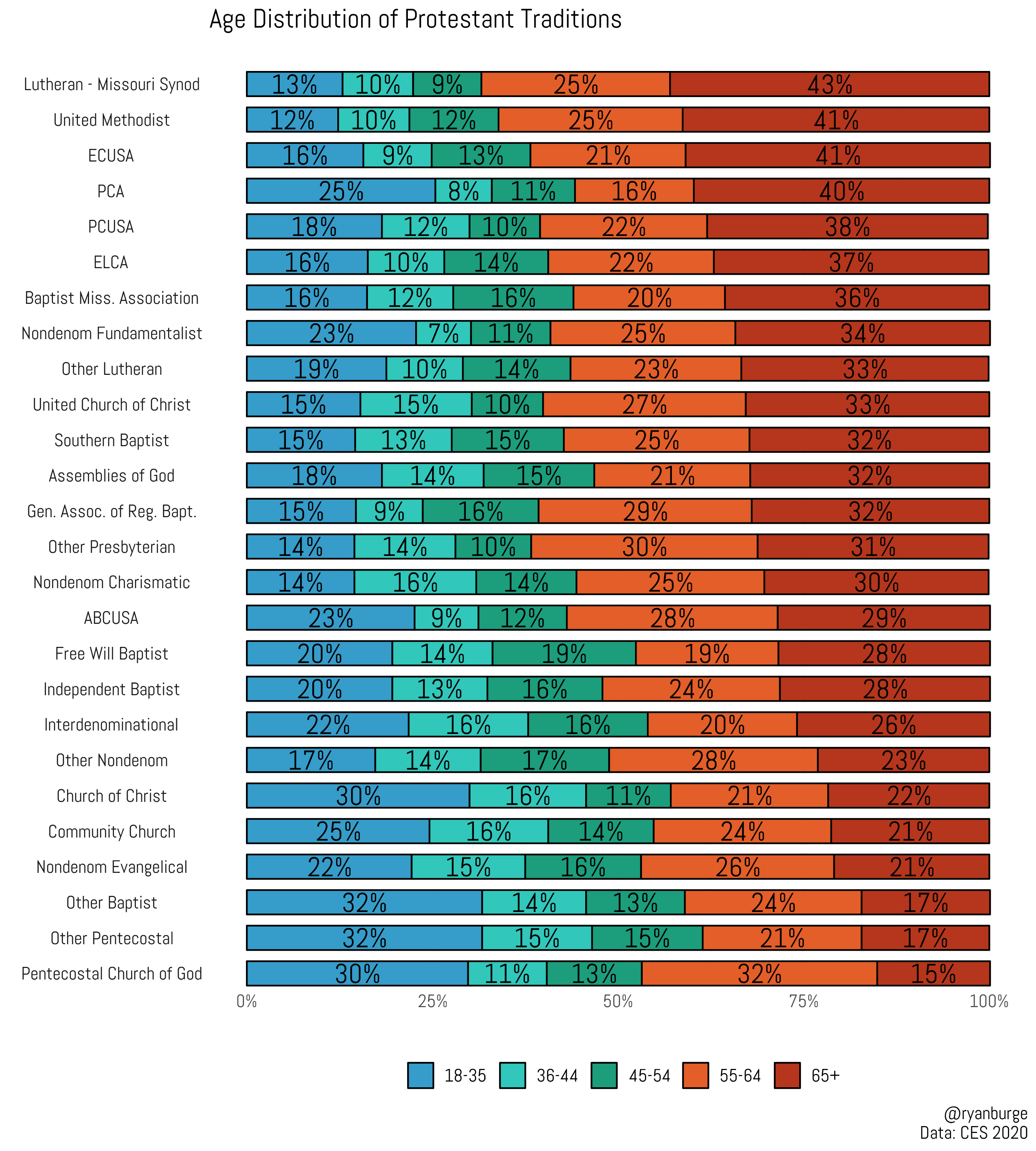
There is much my own Evangelical Presbyterian Church (EPC) can learn from the Presbyterian Church in America (PCA). Although the EPC and PCA hold to the same doctrinal standards, the EPC is shrinking while the PCA is growing. The EPC can learn a lot from our larger partner about how to remain faithfully confessional and missionally relevant in post-Christian America.
Broadly speaking, the PCA is the only non-Pentecostal denomination still growing in the United States. That should cause every leader in the EPC to pay attention: the only non-Pentecostal denomination still growing in America is a confessionally Reformed, doctrinally rigorous church, and it’s not us.
So, here are the usually caveats at the outset. First, while the EPC should desire for its congregations to grow and to become a bigger denomination, our first goal should be to see Christ’s kingdom grow. Second, numerous individual EPC congregations are growing and healthy and some PCA congregations are shrinking and unhealthy. But on the whole, the EPC is shrinking while the PCA is growing, and I am focused on the general contours of both churches. Third, applying principles of denominational growth to individual congregations is immensely difficult. That requires a culture shift and buy-in. Fourth, most of what makes the PCA successful required steps it took 30-40 years ago. The EPC could try and replicate the PCA’s current practices, but without a similar foundation those practices will flounder. At the same time, the EPC cannot simply duplicate what the PCA was doing from 1984-1994 in 2024; the world is different, and so the application of this foundation will by necessity look different…