Happiness for the Church is Intergenerational
On October 13th I’ll be leading a Zoom seminar for the Christian Reformed Church’s Thrive ministry on lifelong discipleship and keeping kids Christian. Join us! Registration is here.
The last few years have seen a significant uptick in research on faith retention for children as they enter adulthood, and for good reason. Just this week I heard of more childhood friends growing up and walking away from the faith. This is a pressing issue as Christianity ceases to be the social default for most of the Western world, with families and churches seeing the kids they love abandoning the faith in greater numbers. Sociologically, figuring who stays and who leaves, and why, is a fascinating question, and sociological research provides good tools to assist the church in its job of discipleship. In that vein, here some articles of which I have recently become aware.
Authoritative Parenting, Not Conservatism, Best for Faith Transmission. There are different styles of parenting: authoritative, wherein parents join clean boundaries and expectations with warmth and open communication; authoritarian, with strict obedience and conformity demanded of kids without warmth or openness; and permissive, where the parents are warm but enforce few standard or expectations. What Amy Adamczyk and Christian Smith discovered in Handing Down the Faith, and what I expanded for the church in Keeping Kids Christian, is that authoritative parenting is by far-and-away the best indicator of childhood faith retention. This was groundbreaking in 2021, and sociologically raised a number of questions about culture and regional differences, though Adamczyk and Smith found that authoritative parenting was effective across cultures.
A study published this April in the Journal of Religion and Health (easier summary here) asked how parenting styles varied in their effectiveness across U.S. regions. Regardless of geographic region, “authoritative parenting acted as a general amplifier for [kids keeping their parent’s faith] across the entire sample.” Interestingly, there was regional variation on whether permissive or authoritarian parenting had positive/negative effects, generally connected to the gender of the parent. For instance, permissive mothering in the South was ineffective, while in the Pacific Northwest permissive mothering was more effective than authoritarian parenting.
Notably, the researchers specifically investigated whether faith was more likely to be transmitted if parents were conservative, but found that there was no effect from conservatism. More research is necessary here, but this helps debunk the idea that merely being a theological/social/political conservative is what transmits the faith…
The “How-To” Book is Done
There is a world of difference between a “how to” book and a how book. The “how-to” is more accessible, but the how will endure.
One of the constant realities of pastoral ministry is that people want you to tell them what to do. Or more specifically, they want you to tell them how to apply and put into practice the principles of whatever your teaching. They want practical checklists. This can become a tension point for a preaching whose theological orientation is towards grace, i.e. what God does. I speak from experience!
I am much more wired to speak naturally about the what and how, not the “how-to”. It’s easier for me to focus on the description of a reality than to shift into the therefore prescription.
This applies to writing as well: when I pitched to the publisher the book that became Keeping Kids Christian, I presented it as a how book; in fact, the original title was How Our Kids Stay Christian…
Passing the Torch So Kids Are Kept Christian
My focus has been elsewhere lately, but in the last few months three significant studies on childhood-to-adulthood faith retention have been published, all which validate the arguments laid out in Keeping Kids Christian.
The Experience of God’s Love in Children. World Vision and the Human Flourishing Program at Harvard University studied how children experience the love of God. Christianity Today has a good write-up of the study. This is slightly different than the question of faith retention, but the “how” covers the same territory: the relationship between children and adults. The study found that children experience the love of God through their families, particularly their parents. Kids understand God’s love, not in abstract categories, but in concrete, relationally grounded human connection. Parents, families, and the adults of the church providing care and guidance is crucial for kids understanding the love of God. All people grab onto models for thinking of God, and kids inherently look to their parents to be that template.
Childhood Experiences with Adulthood Religious Outcomes. Published in the Journal for the Scientific Study of Religion, the authors looked at preexisting data sets to examine seven childhood factors: parental marital status, conversations about faith with parents, childhood religious service attendance, mother/father religious service attendance, and the quality of the relationship with one’s mother/father…
Mere Orthodoxy Web Forum Bonus Q&A
I had a great time participating in Mere Orthodoxy’s first ever author forum to discuss my book Keeping Kids Christian. We ran out of time to cover all the questions, so I wrote up a series of short answers that Mere Orthodoxy published, along with a link to a recording of the forum.
Mere Orthodoxy Forum on Keeping Kids Christian
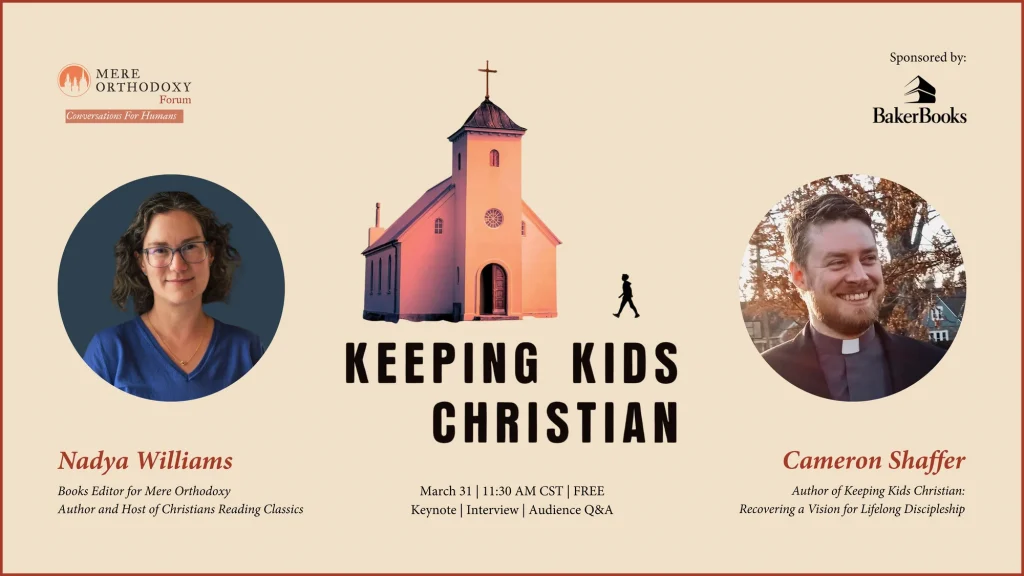
This Tuesday, March 31st, I have the privilege of participating in Mere Orthodoxy’s forum series, “Conversations for Humans”. It’s hosted online and open to the public; you can register for the event here. I’ll be talking about my book Keeping Kids Christian and what the church can do to promote faith transmission to the next generation.